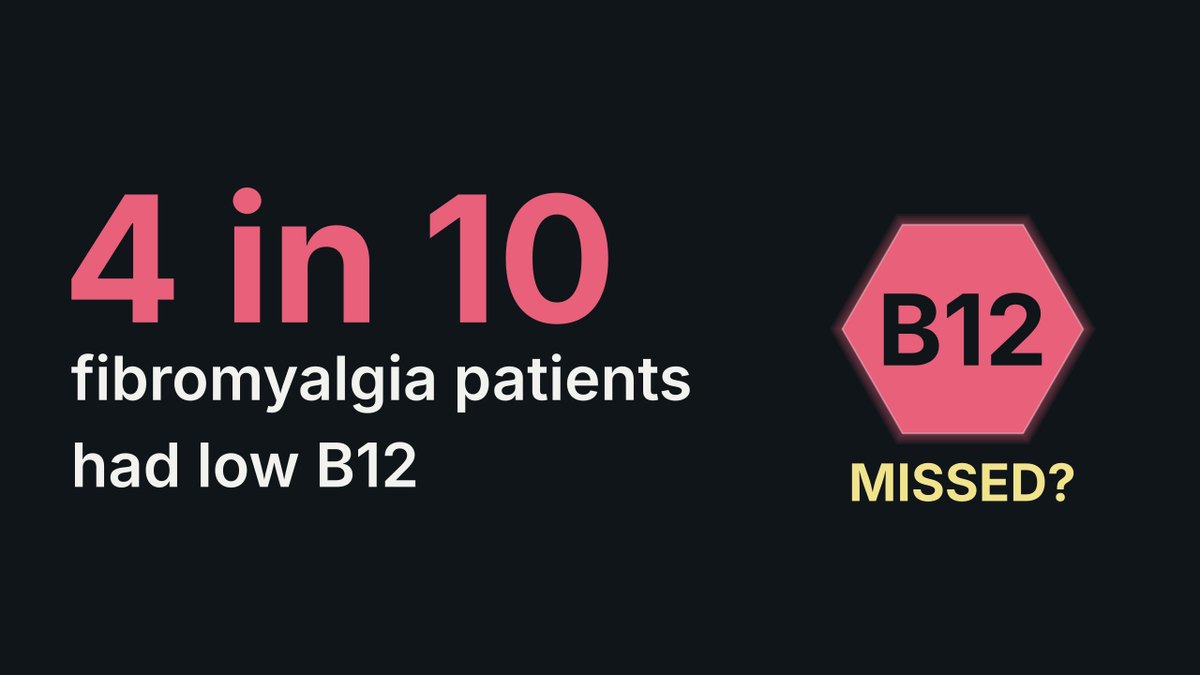
Yes: low vitamin B12 can cause fatigue, tingling, memory trouble and low mood, which overlap heavily with fibromyalgia. In a Mayo Clinic review of 2,142 people with fibromyalgia, 42.4% had B12 below that clinic’s normal range, and the low-B12 group had fatigue noted in their charts more often. That doesn’t mean B12 causes fibromyalgia, but a fibromyalgia label shouldn’t end the search: B12 can be measured and fibromyalgia can’t.
Below: why the two look alike, how B12 travels from your plate to your nerves, where that route can quietly fail, why a normal blood count and a single B12 number can both mislead, and what the Mayo study and newer research can and can’t tell us. Please don’t start, stop or change any medication or supplement because of anything here without talking to your doctor first. Our fibromyalgia page collects our other fibro videos.
Prefer to watch? This article goes with our video, Why Low B12 Gets Mistaken for Fibromyalgia (11 min).
Can B12 deficiency mimic fibromyalgia?
On paper, the symptom lists sit almost on top of each other. Fibromyalgia is defined by widespread pain, but it usually comes with fatigue, unrefreshing sleep, trouble thinking clearly (often called fibro fog) and, for many people, tingling or numbness. B12 deficiency can cause fatigue, numbness and tingling in the hands and feet, poor balance, memory changes and low mood.12
The difference is how each one gets found. There is no blood test for fibromyalgia. It’s diagnosed from the pattern of symptoms. The 2016 revision of the fibromyalgia criteria says plainly that a fibromyalgia diagnosis is valid whatever other diagnoses you have, and that it doesn’t exclude other clinically important illnesses.3 So the label can sit on top of a B12 problem without ruling it out.
How B12 gets from your plate to your nerves
B12 naturally comes only from animal foods: fish, meat, poultry, eggs and dairy.1 In food it’s bound to protein, and getting it into your cells takes a relay of three carrier proteins.4
- Stomach. Stomach acid and protein-cutting enzymes pry B12 loose from food. A carrier from saliva, haptocorrin, picks it up.
- Upper small intestine. Pancreatic enzymes break haptocorrin down, and B12 is handed to intrinsic factor, a protein made by the parietal cells of the stomach lining (the same cells that make stomach acid).
- End of the small intestine. In the terminal ileum, a receptor called cubam pulls the intrinsic factor and B12 pair into the gut lining.
- Blood and cells. B12 leaves on its third carrier, transcobalamin. Only this transcobalamin-bound share, a minority of the B12 in your blood, is delivered into cells.
Inside the cell, B12 becomes two working forms, and each serves one enzyme. One helps recycle homocysteine into methionine, which feeds the body’s main supply of methyl tags used to build neurotransmitters and maintain myelin, the insulation around nerves.5 The other works in the mitochondria and clears methylmalonic acid (MMA) out of the way.4 When B12 runs short, both stall, and homocysteine and MMA build up in the blood. Those two backlogs are what the follow-up tests look for.
Exactly how a shortfall damages nerves still isn’t settled. A 1992 review of animal work pointed mainly at the methionine side, meaning less methylation of myelin. The older idea, that the MMA backlog builds faulty fats into nerve membranes, didn’t hold up as well in those models, and even the methylation explanation doesn’t fit every species studied.5
Where the chain breaks: autoimmune gastritis and pernicious anemia
The most common cause of serious B12 deficiency is poor absorption, not a poor diet. According to the NIH, pernicious anemia is the most common cause of clinically evident B12 deficiency around the world.1
Pernicious anemia is the late stage of autoimmune gastritis, where the immune system attacks the parietal cells.6 Lose those cells and you lose intrinsic factor, so the relay breaks at step two no matter how much B12 is on your plate. Many people with it make antibodies against parietal cells, and some also make antibodies against intrinsic factor itself. The American Gastroenterological Association’s 2021 practice update says that in unexplained B12 or iron deficiency, atrophic gastritis should be considered.6
This is where Hashimoto’s comes in. The same AGA update says other autoimmune disorders, particularly autoimmune thyroid disease, are common in autoimmune gastritis.6 A 2020 meta-analysis of 56 studies and 47,509 people with autoimmune thyroid disease found a second, overt autoimmune disease in 13.46%, mainly type 1 diabetes and autoimmune gastritis. Anti-parietal cell antibodies were among the most common “latent” findings, antibodies without the disease yet.7 Our article on a positive parietal cell antibody explains what that result means and which tests come next. If you have Hashimoto’s and fibro-like symptoms, our article on normal TSH and still tired covers the thyroid side.
Autoimmunity isn’t the only weak point. Long-term use of acid-reducing medicines is linked to lower B12: in a Kaiser Permanente study of 25,956 people newly diagnosed with B12 deficiency and 184,199 without it, two or more years of proton pump inhibitors went with 65% higher odds of deficiency.8 Metformin, gut surgery and older age are other recognized risks.1 That’s a reason to talk with your doctor, not to change anything on your own.
Can you have low B12 with a normal blood count?
Yes. The classic sign of low B12 is anemia with large red blood cells, so many people assume a normal complete blood count rules it out.
In 1988, researchers at Columbia-Presbyterian in New York reported on 141 consecutive patients whose nerve or psychiatric problems were caused by B12 deficiency.9 Forty of them (28%) had no anemia or no enlarged red cells, and in 19, both tests were normal. Their symptoms included tingling, numbness, poor balance and memory loss, often for a long time. Their B12 levels were low in all but 2, and their MMA and homocysteine were markedly raised.
In all 39 of those patients who were followed through treatment, the nerve or psychiatric problems improved once the deficiency was corrected.9 How to correct a deficiency is a medical decision, and it depends on the cause. The point for us is narrower: a normal blood count can’t clear you on its own. The NIH also notes that high folic acid intake can correct the anemia of B12 deficiency while the nerve damage carries on.1
Why one B12 number can mislead
The standard test measures total B12 in your blood, including the large share sitting on haptocorrin that cells can’t readily use.4 Cut-offs vary by lab, but most call levels below about 200 to 250 pg/mL low.1
Between the clearly low and the clearly fine is a gray zone, and it’s big. Using national survey data from 2007 to 2018, about 3.6% of U.S. adults are deficient at the strict cut-off (below 200 pg/mL), while about 12.5%, roughly one in eight, fall below the insufficiency line of 300 pg/mL.1
That’s why guidelines lean on a second test. The NIH says experts suggest checking MMA when B12 is between 150 and 399 pg/mL.1 The UK’s 2024 NICE guideline calls 180 to 350 ng/L (the same as pg/mL) an “indeterminate” result and says to consider MMA when someone in that range has symptoms or signs of deficiency.2 It lists unexplained fatigue among the common symptoms that, together with a risk factor, should prompt a test. One Northern Ireland hospital audited what happened next: in the year after the guideline, MMA requests nearly doubled (57 to 112), and the share that met the guideline’s criteria rose from 47% to 79%.10
| Test | What it measures | The catch |
|---|---|---|
| Serum B12 (total) | All the B12 in your blood, on both carriers.4 | Includes B12 cells can’t use. A low-normal result can hide a shortfall.1 |
| Active B12 (holotranscobalamin) | Only the transcobalamin-bound share that reaches cells.2 | Not offered everywhere. NICE accepts it as a first test too.2 |
| Methylmalonic acid (MMA) | The backlog when the mitochondrial B12 enzyme stalls.1 | The most sensitive marker, but kidney problems and older age raise it too.1 |
| Homocysteine | The backlog when the methionine enzyme stalls.1 | Low folate and reduced kidney function also raise it, so it’s less specific.1 |
| Complete blood count | Anemia and red cell size. | Can be normal even when B12 is affecting nerves.9 |
| Parietal cell and intrinsic factor antibodies | Signs of autoimmune gastritis.6 | Used to help diagnose the cause, alongside stomach biopsies.6 |
The Mayo Clinic study, line by line
This is the study behind the “4 in 10” number. Researchers at Mayo Clinic in Jacksonville, Florida, reviewed the charts of 2,142 patients with fibromyalgia seen between 2015 and 2020, all with B12 and vitamin D results on file.11 Women made up 91.3%.
- 42.4% had B12 below 400 ng/L, which was that clinic’s lower limit of normal.
- After adjusting for vitamin D, low B12 was linked to about 39% higher odds of fatigue being recorded (odds ratio 1.39).
- Memory loss was noted a little more often in the low-B12 group (5.7% vs 4%), a difference that fell just short of statistical significance.
- There was no significant link between low B12 and brain fog, cognitive impairment, numbness or neuropathy.
That last line matters. Those nerve symptoms are what the mechanism predicts, and they weren’t linked to low B12 here. The authors themselves note that the B12 levels usually tied to nerve symptoms are lower than the cut-off they used.
Other studies don’t line up neatly behind it. The Mayo authors cite one study of 58 women that found lower B12 in fibromyalgia, but also one that found no B12 deficiency in 29 people with fibromyalgia and another that found similar levels in people with and without it.11 A 2025 meta-analysis pooled the evidence: across the 3 studies that measured B12, average levels didn’t differ between people with fibromyalgia and healthy controls.12 Vitamin D and ferritin, by contrast, were lower in the fibromyalgia groups.
Our read: the evidence doesn’t point to low B12 as a hidden driver of fibromyalgia for most people. Averages can still hide individuals, and missing a real deficiency can mean nerve damage. That’s a good reason to check, and a poor reason to assume.
If your pain is the “turned-up volume” kind, our article on fibromyalgia headaches explains central sensitization, one of the main proposed mechanisms for fibromyalgia. B12 status can sit alongside it as a separate, measurable thing.
Why we care about this one
Annesse, Kristin’s mom, got sick in the summer of 1992. Exhaustion came first, then muscle pain, daily migraines, a low-grade fever and flu-like aches, and for the next few years she was mostly in bed, unable to wash her hair or climb stairs. She was eventually diagnosed with lupus, along with chronic fatigue syndrome and fibromyalgia. Her early blood work did show something, a high sedimentation rate. But her bloodwork didn’t always match how she felt.
A diagnosis made from a pattern of symptoms is an answer, but it can also become a reason to stop looking. That’s why we think it helps to ask which tests have been run, which haven’t, and what a “normal” result actually covers.
Questions to bring to your doctor
- Has my B12 been measured? If it came back low-normal, would a methylmalonic acid test help show whether my cells are actually short?
- My blood count was normal. Does that rule out a B12 problem in my case, or only anemia?
- I have Hashimoto’s (or another autoimmune condition). Given how often autoimmune gastritis travels with it, is it worth considering for me?
- Could any of my long-term medicines affect B12 absorption, and should we check it over time?
What we still don’t know
Nobody has shown that low B12 causes fibromyalgia, or that correcting a borderline B12 level eases fibromyalgia symptoms. The largest study, from Mayo, was a chart review with a generous cut-off, no comparison group and no MMA results. The 2025 meta-analysis rested on just 3 B12 studies. We couldn’t find a published randomized trial of B12 in people with fibromyalgia. One small open-label study without a placebo group reported improvement, which is weak evidence.13 A small Swedish placebo-controlled trial in 40 women was registered, with its protocol published in 2023, but we found no results yet.14 How a B12 shortfall damages nerves is still argued over, mostly from animal models.
Quick answers
Can B12 deficiency be mistaken for fibromyalgia?
It can. Both can cause fatigue, tingling, memory trouble and low mood, and fibromyalgia is diagnosed from symptoms, not a blood test.
Can B12 deficiency cause fibromyalgia?
There’s no evidence that it does. A Mayo Clinic chart review linked lower B12 to more recorded fatigue in fibromyalgia, but a 2025 meta-analysis found average B12 levels no different from healthy controls.
Can you have B12 deficiency with a normal blood count?
Yes. In a 1988 study of 141 people with nerve or psychiatric problems from B12 deficiency, 28% had no anemia or no enlarged red cells. Methylmalonic acid and homocysteine were markedly raised.
Is pernicious anemia linked to Hashimoto’s?
They often travel together. Pernicious anemia is the late stage of autoimmune gastritis, and gastroenterology guidance says autoimmune thyroid disease is common in people with autoimmune gastritis.
Does B12 help fibromyalgia?
We couldn’t find a published randomized, placebo-controlled trial in people with fibromyalgia. One small open-label study of 28 women reported lower symptom scores, but with no placebo group it can’t separate B12 from expectation. If you’re actually deficient, the deficiency itself needs treating, and your doctor decides how.
Sources
- NIH Office of Dietary Supplements. Vitamin B12: Fact Sheet for Health Professionals. Accessed November 4, 2026. ods.od.nih.gov/factsheets/VitaminB12-HealthProfessional/
- Sands T, et al. Vitamin B12 deficiency: NICE guideline summary. BMJ. 2024;385:q1019. doi.org/10.1136/bmj.q1019
- Wolfe F, et al. 2016 Revisions to the 2010/2011 fibromyalgia diagnostic criteria. Semin Arthritis Rheum. 2016;46(3):319-329. doi.org/10.1016/j.semarthrit.2016.08.012
- Mucha P, et al. Vitamin B12 metabolism: a network of multi-protein mediated processes. Int J Mol Sci. 2024;25(15):8021. doi.org/10.3390/ijms25158021
- Metz J. Cobalamin deficiency and the pathogenesis of nervous system disease. Annu Rev Nutr. 1992;12:59-79. doi.org/10.1146/annurev.nu.12.070192.000423
- Shah SC, et al. AGA Clinical Practice Update on the Diagnosis and Management of Atrophic Gastritis: Expert Review. Gastroenterology. 2021;161(4):1325-1332.e7. doi.org/10.1053/j.gastro.2021.06.078
- Botello A, et al. Prevalence of latent and overt polyautoimmunity in autoimmune thyroid disease: a systematic review and meta-analysis. Clin Endocrinol (Oxf). 2020;93(4):375-389. doi.org/10.1111/cen.14304
- Lam JR, et al. Proton pump inhibitor and histamine 2 receptor antagonist use and vitamin B12 deficiency. JAMA. 2013;310(22):2435-2442. doi.org/10.1001/jama.2013.280490
- Lindenbaum J, et al. Neuropsychiatric disorders caused by cobalamin deficiency in the absence of anemia or macrocytosis. N Engl J Med. 1988;318(26):1720-1728. doi.org/10.1056/NEJM198806303182604
- Roulston G, et al. Clinical audit of plasma methylmalonic acid (MMA) requests following publication of NICE guidelines on vitamin B12 deficiency in over 16s. Ann Clin Biochem. 2026 (published online May 8). doi.org/10.1177/00045632261453328
- Munipalli B, et al. Association of vitamin B12, vitamin D, and thyroid-stimulating hormone with fatigue and neurologic symptoms in patients with fibromyalgia. Mayo Clin Proc Innov Qual Outcomes. 2022;6(4):381-387. doi.org/10.1016/j.mayocpiqo.2022.06.003
- Ismail O, et al. Differences in ferritin, vitamin D, and vitamin B12 between fibromyalgia patients and healthy individuals: a systematic review and meta-analysis. Musculoskeletal Care. 2025;23(1):e70057. doi.org/10.1002/msc.70057
- Gharibpoor F, et al. Effect of vitamin B12 on the symptom severity and psychological profile of fibromyalgia patients; a prospective pre-post study. BMC Rheumatol. 2022;6(1):51. doi.org/10.1186/s41927-022-00282-y
- Sall Hansson K, et al. Efficacy of mecobalamin (vitamin B12) in the treatment of long-term pain in women diagnosed with fibromyalgia: protocol for a randomised, placebo-controlled trial. BMJ Open. 2023;13(3):e066987. doi.org/10.1136/bmjopen-2022-066987
How we made this article. We start from the research behind our video, draft with help from AI writing tools, and check every number and claim against the original papers listed above. Last fact-check: November 4, 2026. Spot an error? Tell us on any of our channels and we’ll fix it.
This article is education, not medical advice. It doesn’t diagnose or treat any condition. Talk to your doctor before changing your care, and never stop or change a medication on your own.